
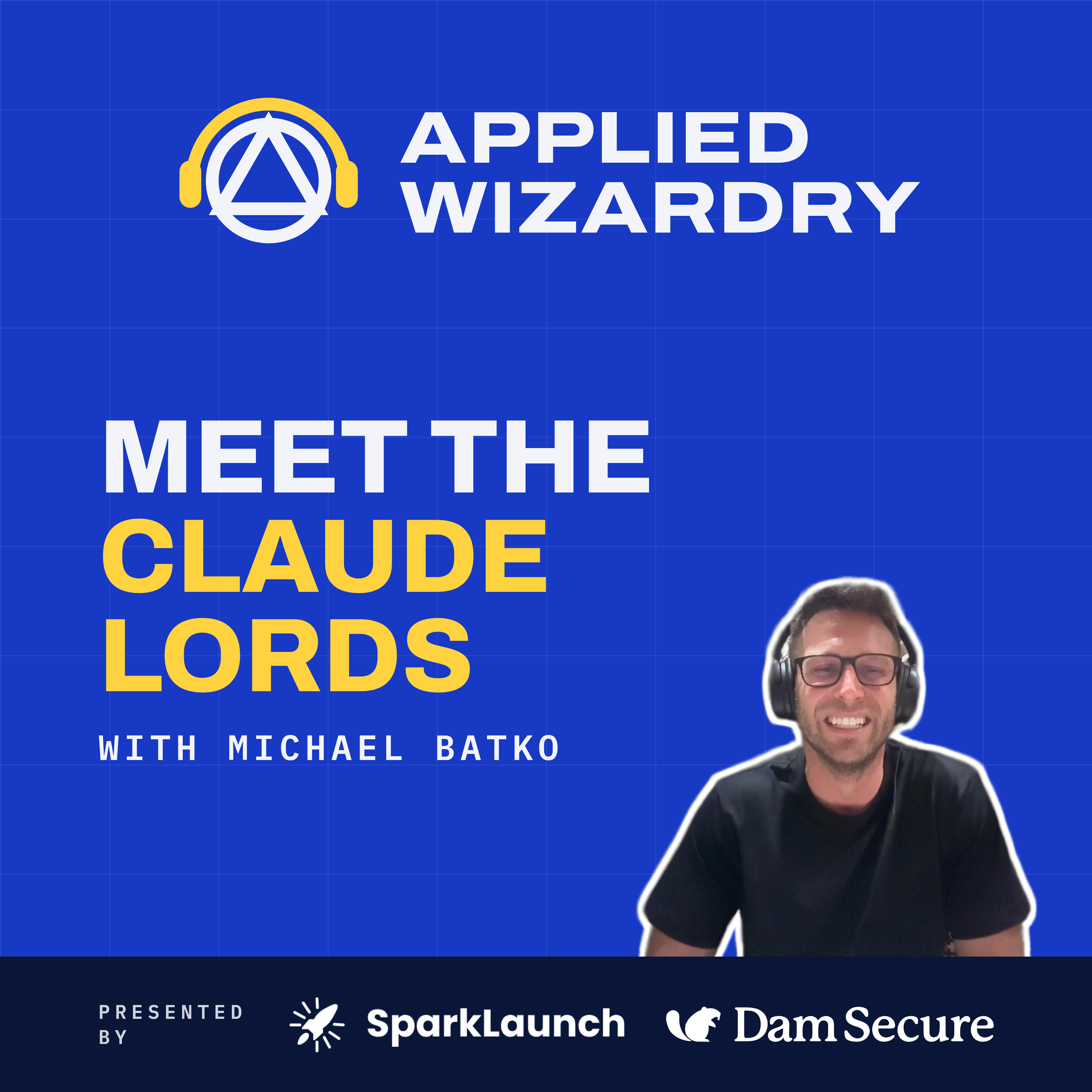
How Michael Batko gets AI to do the busywork
The outsized returns from AI come from revenue growth, not cost-cutting—yet 99% of businesses outside the tech bubble have barely started exploring it. Michael Batko, former Startmate CEO and now founder of Hourglass AI, joins Yaniv to discuss how he helps companies of 20-100 people with no engineering team build bespoke AI systems. The conversation covers the company 'AI brain' built from structured Markdown files, the skills-based collaboration model that prevents teams from rebuilding the same tools, and why behaviour change is the hardest part of any AI transformation. For engineers and founders, the episode is a practical look at what actually works when AI building is cheap but maintenance and adoption remain hard.
Show notes
Key takeaways
- Custom software for N-of-1 use cases is now viable because AI has collapsed build speed and cost, making bespoke solutions economical for SMBs that could never afford them before.
- The two hardest bottlenecks in AI adoption are behaviour change and systematic thinking about processes—technology is the easy part.
- Hourglass AI builds a 'company AI brain' as a structured Markdown file tree ingested from inboxes, CRMs and documents, refreshed daily, with access controls ring-fenced by person.
- Skills are maintained separately from knowledge: one person builds a workflow skill, an admin approves updates, and the whole team uses it, preventing inconsistent duplicate tools.
- The highest-ROI automations are post-meeting follow-up emails, inbox management with full company context, and finding revenue triggers like DA approvals for timely outreach.
- Michael's personal terminal setup opens Claude Code projects with a single keystroke, continuing conversations across his own brain, client brains and work folders.
- Most people's AI experience remains a chat box Q&A; the mindset shift comes when they see something built or done agentically rather than just answered.
Chapters
- 00:00 Revenue vs Cost Cutting
- 02:43 Hourglass AI Model
- 04:23 Speed and Customisation
- 07:49 The Real Bottlenecks
- 10:09 Discovery and Specs
- 14:37 Building vs Maintaining
- 19:45 Company AI Brain
- 21:57 Skills and Collaboration
- 29:46 Batko's Terminal Setup
- 44:46 Claude Lords and Champions
- 49:29 Speed of Change
- 52:20 Agents and Wallets
Links and tools mentioned
- Hourglass AI: https://thehourglass.ai
- Startmate: https://startmate.com
- Granola: https://www.granola.ai
- Claude: https://claude.ai
- Apify: https://apify.com
- Supabase: https://supabase.com
- NitroSend: https://nitrosend.com
- Obsidian: https://obsidian.md
- Data for SEO: https://dataforseo.com
About Michael Batko
Michael Batko is the founder of Hourglass AI, which helps companies implement AI to improve productivity, and was previously CEO of Startmate, Australia's largest accelerator, for eight years.
This episode is presented by SparkLaunch and Dam Secure.
- SparkLaunch (https://sparklaunch.io/wizardry): Applied Wizardry listeners get an extra 20% off.
- Dam Secure (https://damsecure.ai/wizardry): Applied Wizardry listeners get their first month free.
Credits
- Justin McArthur, Executive Producer and Video Editor: https://www.linkedin.com/in/justin-mcarthur/
- Steph Hefferan, Editor: https://www.linkedin.com/in/steph-heff/
Transcript
The outsized returns you can get with AI are usually not actually on the cost cutting side of things, it's actually on the revenue building side of things.
When you have an agent that could do all your shopping for you, you're going to give it your credit card.
You and I are in this massive bubble and what I mean by bubble is like we're in startups, we're in VC, we're like talking to tech people, everybody's using AI around us and it just like feels like no brainer. Everybody else should be using it. How will you get my dinosaurs on board with this change?
Whatever business you're in, whether you have just founded your own startup, you're at a growing company or you're at a more traditional business SME or anything else, you are dealing with dozens of processes that are formulaic, not written down anywhere and they drain on your time and even more importantly on your energy. So how do you automate all of that stuff with AI? We have got the perfect guest. He's been helping dozens of companies do it. He is startup royalty and he knows everything about this space. Can't wait to get into it with him right after this break. One of the amazing things about AI is it allows you to turn your idea into a real business faster than ever before. But you don't want to let yourself get dragged down by paperwork, bureaucracy and government stuff like that. So that's why you need today's sponsor, Spark Launch for just $499. Their Delaware C Corp formation package includes Delaware filing and your first year of registered agent service. Plus keep your company documents and founder equity organized as you grow so you can focus on building the business. You build the product. Spark Launch helps you start the company. Visit SparkLaunch.IO/Wizardry to get another 20% off their already great deals and get started. This episode of Applied Wizardry is brought to you by Dam Secure. DamSecure is the code security platform for AI-first engineering teams get top tier security PR reviews at a fraction of the cost of other models and get through your PRs 32% faster. Don't just take my word for it, head over to DamSecure.AI/Wizardry. That's D A M Secure AI Wizardry for your first month completely free. If you've worked in startups in Australia, Michael Batko needs no introduction. He was the CEO of Startmate, the country's largest and most prestigious accelerator for what was it, eight years, wasn't it? He actually left earlier this year and is now the founder of a company called Hourglass AI, which is helping companies all across the spectrum use AI to become way more productive. And we're going to go into all the tips, secrets, learnings and surprises today. Batko, welcome to Applied Wizardry.
Thanks so much for having me.
Well, let's just jump straight in.
Yeah, let's start. I left Startmate and now I'm building Hourglass AI. Hourglass AI, we go into companies, we ask about all the problems and we build the AI solutions for them really practically. And it's literally around the outcomes that people want. Like we don't shy away from custom work, we just want the whole team to be using AI and just solve their problems. So there's like no products that we're necessarily selling, which is probably a little bit counterintuitive compared to what I was always preaching at Startmate around scalability and VC. But honestly that's what I enjoy the most. Essentially we go into businesses, we solve the AI or like the IT challenges. So often it's also just around building deterministic software as well. It's not always fully AI, kind of like Applied Wizardry, but the types of companies that we work with are really fun because we now work with venture capital firms, financial services, we work with an accounting company, a forestry and meat processing business. So like SMB versus kind of like VC and startups and financial services, it's very different, especially SMB.
I'm curious, like, why did you decide to start doing this? Obviously you had this amazing role at Startmate and you were sort of very in the, like you said, tech product ecosystem and now you are. I guess what, what you're describing here is a consultancy service that builds in a sort of forward deployed way across these businesses. So what did you see and what, what kind of got you, got you there.
After eight years at Startmate, it was just time for me to do something different. And the only reason I say that is because I was like, I'm 35, the world's a big place, there's so many opportunities I need to do and try to, to do something myself, otherwise I'll always regret it. So that was actually completely separate to me than starting it because when I left Startmate, I had no idea what I'll do. I was like, I've got the best job ever. I'm like investing in founders, helping them out, raising money and just like seeing people progress. I loved it. So it's literally like, it was very scary because like, will I ever find a job this fun again? But then I left and took a couple months out and I literally gave myself permission for three to six months to just have fun, experiment and, and then Hourglass, the reason for it or the reason I started it is because most people know me for my productivity and I like, literally like help people set up their inboxes and to do lists. And how do you actually, like get more done and have more time with your family and loved ones?
That was always like a side hustle of yours, wasn't it? You had things called Puddlepod and I think some other stuff, right, where you're like, you were a bit of a productivity guru.
I mean, this is because most people knew me for. Because I exactly had the side hustle, which I didn't sold. I trained like 500 people, had to become more productive and so on. But now with Hourglass AI, I literally get to do that on steroids because now I get to like make whole companies super productive, which is like, I love that
you've always been a bit of a productivity guru. And yeah, you know, watching from the outside, simply the fact that you can run Australia's largest accelerator and still have time for a side hustle is in itself a good advertisement for how good you are at being productive and managing your time. So now I guess you saw AI come along and what did you see AI as being most capable of in terms of from a productivity mindset? And I think for all of us building with AI, it's like, well, wow, we've got this superpower tool, right? But how do we use it to make sure that we do get that 10x speed up? It slightly changes the game, doesn't it?
Oh my God, it's crazy. From a high level, what it changes is essentially two things, like, number one, speed and number two, customization. So like the speed of building has never been faster, Right? We all know it. Like you can actually ship something and especially if you're non technical, you can actually get something out there which you previously just never even could dream of. And the other one, though, which people underestimate is actually the customization. Previously you always had to run a waterfall to build one custom product for like those 15 enterprise clients and you could never like swerve away from that. Whereas now nothing stops you to like build the most crazy custom stuff for every single person. And obviously this is what Hourglass does. I even had conversations with SaaS founders now who are like, previously our advice was like, never ever that can do custom work for any of your clients. But now they're just like, why not? It's actually quite fast and as long as you keep the core kind of consistent, it can potentially work. So some of them actually started experimenting with that as well. Now
one thing that bringing it to that topic of productivity and all of these businesses that you work with, there's a narrative in the media, let's say, which I think is somewhat valid, which is so much money has gone into AI. There has been so much said about the incredible transformational power of this technology. When you do stuff with it, you're like, wow, this is incredible. But then you look out to the broader economy. It doesn't feel like the world is massively changing in that same sort of hurry. And so I always think like, what are the true constraints and bottlenecks that you are seeing to being able to unlock the power of the technology and how are you approaching them?
Totally. Oh my God, such a great question. So true. Number one, you and I are in this massive bubble. And what I mean by bubble is like we are in startups, we're in VC, we're like talking to tech people. Everybody's using AI around us and it just like feels like no brainer. Everybody else should be using it. I now pitch SMBs and I can tell you not everybody's ready to do it. And even the SMBs who are actually approaching us, I'm like, you are literally ahead of the wave because you are the top 1% who even is thinking about adopting it. So I'm getting super disillusioned with 99% of the businesses, haven't even started exploring it. And then to your question of what's actually blocking it, it's really two things. Number one, and it's the hardest thing is behavior change and two, systematic thinking. So behavior change hardest. When I do an AI transformation for a company, there's the tech side and there's behavior side. The tech side actually is quite easy because you can launch things much faster, much more custom, specifically to an outcome now. Whereas the behavior change, so much harder. Every single client asks us. Actually I just got off a client call just then and the first question they asked is like, how do you get my team on board to actually using AI? The team of 35 people, so not even that large, but they already concerned that the team might not use it because they're just scared of change. Like it is a big, big shift in the way you work. Like first thing I do when I open my laptop, I've got eight Claude Code windows that open at any given time and that's what I do. Like manage my inbox, manage my calendar, whatever it. And I literally don't even use the interfaces anymore that we previously used. But it is scary to people who haven't done it before. They actually, the clients who I just got off call with, they called it, how will you get my dinosaurs on board with this change? And that's the behavior change. It's so hard.
Yeah. Oh God. There's so many different directions I want to go right now. But I guess the first aspect of it, which is I think you were sort of talking about like process, right? When the cost of building anything becomes so much lower, the question then becomes, do I actually know what I'm building? Right? And there's that sort of like product slop which is like, sure, you've built something that's vaguely product shaped but it's not actually useful because you haven't done the product thinking. And there's an equivalent there, right, where it's like, sure, we've got a business that runs a certain way, there are things that can be automated, but it's probably pretty easy to create automation slop, right?
Oh, 100%. Okay, two answers to this question. Number one is doing the discovery well. And number two is human in the loop, which I can tell you about. Number one is actually just doing the discovery well. Like it's so easy to build stuff. So probably you and I have built like 100 agents and 24 hours later, some of them don't work anymore. And then you discard all of them and then you just revert back to like the best three you've actually built. And that is because the discovery hasn't been done well. Where like, what is actually truly important to you and what will save you the most time and or make you the most money. That is what we now do with businesses really well where we go in and we actually do as step number one, we actually audit them. We go in, interview your team and you actually tell us like, what do you wish existed? But also like, what do you spend most of your time on? The best way to discover what people truly want is not to ask them of like, how often are you going to go in the gym next next week? Because everybody's going to be like, oh yeah, five times a week. Especially to ask them, well, how often did you go to the gym last week? And suddenly the answer is very different. So someone's like, not what are you going to do next week with AI? But it's actually like, how much time have you spent on X and Y and Z in the last week
there's that term revealed preference. Right. And I guess it's like also revealed process. It's like what you've written down in your policy documents and what you actually do.
Is that
sort of what you're getting at?
Absolutely, yeah. Yeah. So it's like you want the actual practical part, not just the wishful thinking. Yeah,
yeah. And I think the fascinating thing about this is doing an audit like this on business processes would always have been valuable, right? Even before AI to do the audit and then you do your process improvement. And you know, of course there are consultants that do that. A lot of private equity firms are effectively going in there and saying, okay, how do I make this business more productive? But I guess what AI now gives us is a forcing function and a real reason for every business to be doing this. So it's like this first step that you're doing is in a sense nothing to do with AI. It is a precondition that is now more valuable because of AI. But really you're talking about like business process mapping or whatever you'd call it, right?
I mean, totally. Like previously there was a job of product managers, right, to actually understand your customer well. But previously you couldn't even uncover all those problems that well because it was a waterfall process anyway. You kind of had to go at the core. Then you did a bit more customer discovery, then you went deeper and deeper. Whereas now with AI, you actually need all of that context up front to do that really well. Because now you can almost one shot builds.
If you have a clear enough spec, then you can one shot build.
Yes, exactly.
Building is no longer the bottleneck. The spec is the bottleneck. It's interesting, you know, you mentioned the product manager thing. I guess one of the challenges in the past of mass produced software, right? You needed to mass produce software, unless you were a very big company to amortize the very high cost of building, right. Otherwise it would just be simply too expensive to build custom software for yourself. And then what that meant is that a big part of the discovery process is trying to find the common factors across many, many different potential customers and abstracting that away. But I guess what AI allows you to do is build that n of one bespoke software for anybody, right? And that means the software only needs to know exactly how you do things rather than in some sense, you know, have all the configurability or abstract that away. It's just like, okay, if we understand the process, we can now build software that does the process.
Yes, I love that. And you can make it really practical. Like this is kind of our ICP now, which is essentially companies of 20 to 100 FTE with no engineering team. Why? Because they literally can't build it themselves previously, whereas now we can actually go in and build it specifically for the company. And the other ICP, which is really interesting. Exactly to the point you just mentioned, there is actually SMBs. So let's actually take the meat processing business as an example, which is amazing because there is no meat processing software. Nobody's ever done that mass build that you mentioned for me, the meat processing industry. Why? Because it's probably like really hard to do marketing and sales for those guys. Whereas now with AI, I'm like, what outcome do you want? Let me build literally this n of 1 software for you specifically to solve your problem.
Let's get into the nuts and bolts of it because I'm a software engineer. A lot of people listening to this podcast are software engineers. And I have concerns is the right way to think about it. It's like, okay, so it's one thing to build n of one software, it's another thing to maintain it. And there are various old rules of thumb in software engineering, which is like only 10% of the cost of building software is the build phase and the other 90% is maintenance. And so I'd love to understand how you go in there and then you do this sort of automation work in a way that this thing is going to be robust and self healing and be able to grow with the business and doesn't just sort of become this white elephant that seemed like a great idea at the time.
I mean this is kind of like the beauty of the business that we're building where we always tell our customers we're going to be here for the long term with you. Like we essentially care about the outcome. Not just now, in the next three months, but we're actually going to be a partner for you for the next few years. Because when we build it, and we exactly acknowledge what you just said there, like software requirements will keep changing, you're probably going to get more people on board, you're probably going to want to recut it, you're probably going to want to have changes and so on. So the way we actually do it is and we build that MVP, get it, live with the client and then actually stay with them with like a maintenance fee to keep making small changes and iterations along the way. Because we recognize exactly that of like the software will keep changing. And with AI you can actually keep changing it to fit exactly your need at the right time as well.
What about technical debt? I guess, you know, another thing I think about is like, okay, you build your software, it has a domain model, a data model, a database, and so on. And then over time as you make changes, things get a little bit messier. The data model maybe doesn't quite match the new way the software works and so on. And I guess a lot of software engineering disciplines over the years, things like version control and observability and migrations and other controls like that have emerged in response to, oh, things get messy down the line. And this is how we manage that. Obviously you're early in your Hourglass journey, but when people started building critical business pipelines using tools like Zapier or N8N, I'm like, that's great. But you realize that you've now built critical business functionality effectively vibe coded it. Are you aware of the risks of that? So like, how do you think about that? Because obviously the biggest value comes from automating or supplementing the most important parts of the business, but you're then creating a fairly critical failure point for the business.
That's an awesome point because I probably actually see it slightly different. I agree with the premise of like, the critical business software is technically like the biggest lift you could do to actually drive the most value for business. But from an AI perspective back to what does the client actually care about? It's usually just two things. One is I want to save time or save expenses. The other one is make more money. And then the critical software part is actually that's just an assumption of, for example, vibe coding your CRM. I actually personally never go there because what I actually care about is solving those outcomes. So what I care about is where do you spend most time? To be honest, the answer usually, especially with financial services VC, is in my inbox. Sure it's critical infrastructure, but like the AI solution here is for me to pre draft all your emails based on perfect context from the entire company on the company AI brain. And that kind of thing like, is actually very simple to do and or doesn't necessarily incur that much critical infrastructure tech debt. The other side is again like making more money, which is again like a way more simple kind of automation of finding your custom segments, emailing them. But a point is almost like with the stuff that we're building, we always try to keep it as simple as possible. Like every single one of our builds only does one thing and does that really well rather than just bloating IT into this massive system that controls everything
that makes sense. So you're managing risk by not touching the critical systems.
Yeah, honestly my pitch to go back to clients is almost like the critical infrastructure is actually your unique IP. That's the part which you actually should be doing incredibly well and you almost don't want somebody external to touch it and to do it for you. For example, if you took a company which is prides themselves in branding and marketing, like I should not be doing your branding and marketing with AI, otherwise like you're just going to AI slop it
now. That's true. Let's get into like practical examples. You've worked with and helped a whole bunch of companies. Now what are perhaps the top three, four, five use cases and automations that tend to deliver the biggest return for these companies? How do you build them as concretely as possible without giving away any of your special sauce? And also what surprised you the most along the way?
Our engagements usually start with context and collaboration. Context is a company AI brain and collaboration is essentially sharing skills and workflows with each other. And those two things already unlock all of the businesses that we work with. Context itself. Company AI brain is essentially sucking in all of your information from inbox, CRM and wherever else. And from a technical perspective, honestly, it's actually very simple. It is a perfectly structured MD file tree that sits on the company servers as well from a cybersecurity perspective. And they control it, they can take it wherever they want to. They can plug any AI into it as well. So
this is like an Obsidian type of thing.
Yeah, so like Obsidian kind of like from like a front end. Yeah, so that's kind of like the visualization.
Okay, so you've got this markdown tree sitting there in its own repository. I guess it's sort of again two aspects of that. One is how do you build it initially and then the second is how do you maintain it?
I mean I'll give you kind of like the high level here because I'm definitely a non technical part of our team. But the first one is the ingestion, which is the big bulk because for example we've had to download like 14 years worth of data of companies and like hundreds of thousands of files. And that's actually the tricky challenge for like building ingestors essentially across all the different software that companies have. And then there we actually do pretty custom stuff. For example, some of the limitations were like massive PDF files or even just like Notion attachments and stuff. And then from like a keeping ingesting perspective. What we do then is overnight, every single day on a 24 hourly kind of basis. We just suck in all the context from companies over and over again. And the way the MD file is structured and works is it specifies with each one of them who actually should have access to it in the company as well. Because you want to ring fence information across people in a company as well. And then you kind of keep restructuring that MD file tree as well based on the kind of usage. For example, if a company has multiple rebrands, you obviously never want to use like an old brand. You just always put like the newest brand on top and stuff. So there's like a whole kind of like continuous restructuring of the MD file tree as well. Which is why that maintenance is important because we stay with our clients over the long term.
And so in a sense, part of your secret sauce is you have like a brain ingest harness that kind of is able to build this brain.
Yeah, that's right.
Okay, so you said that's usually the first step, what happens after that?
So usually the second step is once you've got the brain. Honestly, companies actually love it already because suddenly the whole team, when they actually chat to Claude or ChatGPT, they suddenly have like such awesome context. Because now every presentation you do is based on company colors. You've got your tone of voice, you even have your personal tone of voice as well if you want to draft your emails, etc. So like the context itself is already a massive unlock for lots of our clients. The second one is then collaboration. As you can think about companies, that's called 40 to 50 FTE. Like everybody's getting excited about AI. Everybody builds themselves the same tools. Venture capital industry, we've got three, four VC funds, we work with like investment team. Every single one of them builds themselves a due diligence AI. The problem is they're all inconsistent, they all do different things. So now with collaboration, really the simplest thing that we can do is is have one person build the skill, put it in, and then everybody in the company has instant access to that skill and you actually just maintain one skill at the time.
So, so the brain includes also skill files as sort of part of the broader repository.
So that would be like the second kind of build that we usually do for companies. Yeah, so then you for example, even have an admin who can approve whether a skill gets updated or not and kind of maintain the skill repository across the company.
So in some sense you've got the knowledge itself, you've got facts In a sense. And they go in as the brain and then you've got processes and they kind of go in as skills. It's like this is what a DD document looks like. This is the data we pull, this is the analysis we do, this is the final format and then we sort of put that in. So now we've got a central set of, I guess, nouns and verbs, which is handy. What next?
Yeah, I love that. That's actually a great analogy. And honestly, even with those two things, people already are flying because like, you've got perfect context. You can actually share things across the team. Things don't keep breaking down. You can actually have consistency across the team as well. What comes next completely depends on each company. For example, we're working with a forestry company. They really wanted us to increase the revenue. So essentially their idea was we want to scrape all those government websites and the DA approvals and then whenever somebody's got a DA approval, put our super premium wood in front of essentially the client. So that's a great way to just do outreach at the right time at the right place.
Sorry, I'm laughing because you said put super premium wood in front of a client and I've just got a 12 year old's brain. Yeah, it's like premium wood in front of your client. I don't know if we cut that or if we make that part of our cold open editors. Anyway, Now I wanted to take a moment to talk about cybersecurity and one of today's sponsors, DAM Secure. Really caring about building secure software is one of the key differences between agentic AI software development and mere vibe coding and DamSecure specialize on providing security PR reviews for you and your AI-first engineering team. They do their own research on the latest models and they learn your code base. The result is you get PR reviews that are security focused and faster and cheaper than the general models with far less noise and unnecessary reports. So you can focus on fixing the security issues that really matter and get back to building for your customers. DAM Secure is offering Applied Wizardry listeners one month for free. If you go to DamSecure.AI/Wizardry, that's DamSecure.AI/Wizardry to claim your first month completely free. Building with AI allows you to get your business started so quickly. But to do that right, you need a partner that helps you do the paperwork and the bureaucracy at the same speed. With today's sponsor, Spark Launch, you can create your startup in seconds using their platform, or you can even plug in your favorite AI tool and it can talk to it directly for just $499, you get a Delaware C corp formed. Now, Delaware C corporations are a really great choice for startups all over the world. A lot of investors will only invest in Delaware C Corps as well as the registration. That $499 package helps you keep company documents and founder equity organized as you grow. Now for Applied Wizardry listeners, you get another 20% off the already fantastic price. So go to SparkLaunch.IO/Wizardry. That's SparkLaunch.IO/Wizardry to claim another 20% off. I'm keen to dive even deeper into some of these things. So like you kind of just mentioned scraping external data. Like are there tools? And you know, I'd love it if you name like specific technologies or providers where like these are tools that our users typically find to be very valuable for things like getting access to certain data or stuff like that that basically your skill files will tend to make use of. Or is it still fairly vanilla? Just the sort of out of the box harnesses these days from the major labs can do so much. Is that generally enough?
Honestly, 95%. It's exactly what you said. The general kind of harnesses. We actually love working with Claude itself and you can pretty much do most of the things there. One specific tool I could actually maybe mention is one of our clients has lots of sponsors and he himself does lots of filming. He needs to report all of those numbers in terms of social media back to the sponsors every single month. Takes him hours and hours every single month for each client. So instead we've built him that report of like just literally press a button and sucks in all of your social media data across all of his clients and puts this perfect report together. And that I believe we've actually built it for an app called Apify, which then actually makes our lives a lot easier to not have to connect with Instagram, connect with X and Y and Z, but actually just scrapes it all for us. So then it is sometimes actually worth paying whatever it is, 30 bucks per month to not have to custom build every single thing.
And that's sort of what I was getting at. I've used Apify and similar tools where it's like, okay, the LLMs, the more tools you give them, the more they can achieve. And there are now these companies, these effectively SaaS, sort of MCP type companies that are basically, basically saying let's have an interface to useful data or useful functionality. I've used Apify, for example, for my personal uses, just to keep a watch list of various flights I might want to book and alert me when I get a lower price. Another one that I've found useful is Data for SEO, which is basically a bit like Semrush or something like that, but it's built as an MCP only, right? So basically if you want to do some SEO optimization for your site or you know, figure out what content to create, you give that to your agent and it can go ahead and give you useful information there. So yeah, I don't know if there are any other ones like that that you've also come across that have been useful.
I mean it's all the standard ones where like to be fair, if you actually do SEO well these days you actually even get ranked on AI to get recommended. The classic one here is Supabase for the database itself. I think everybody is using it now because it's like the first thing that Claude recommends. Second one is actually for example, for lots of emails to clients and sending out emails en masse for like your direct consumer product, for example. There's actually an Aussie company called Nitrosend now as well, which you can actually use. But those types of things, like, sure, you can vibe code it, or you can kind of like build yourself the connectors, etc. But like, is it worth it? If it's 30 bucks per month, you're probably better just buying it.
I'd love to go into like a few more processes and you know, also obviously you're working with VCs, SMEs, but you've got a long heritage of working with startups. I'm a startup founder. I think a lot of people listening to this are working in startups. Like what are some of the productivity drains that you typically see affecting people working in startups and how can they automate some of those or take away some of that burden?
You know what, I'll make it super practical. I'll tell you about my favorite workflow which I think every single founder should actually have. The one which I use religiously every single day and I think I use it literally like six or seven times a day is just the simplest one possible which is post-meeting follow up emails. It's like number one, you have a meeting, you 100% have to record it. Like I love using Granola. Granola just sits there, records the whole meeting. As soon as the Granola finishes, a Claude Code window opens up, summarizes the meeting itself. It goes more through my Batgo AI brain, finds my tone of language, finds all of the previous kind of connections that I've had with that particular person and drafts that perfect kind of reply back to the person. The reason why Claude Code is great because I can then whisper flow back into it if I want to make any changes, otherwise you shoot it off. Second part of the workflow is actually even more magical though, because it actually finds who introduced me to that person, if anyone introduced me, and also drafts an email saying thank you, this is what we chatted about. I really appreciated the introduction. So that's always beautiful because like nobody ever loops back with you when you do an introductions and I do a lot of introductions and people do them for me too. And the final part of the workflow is actually one where it then takes the whole conversation and even suggests a blog post I should write about the topic because it could be interesting in something I haven't written about before and even then itself is actually a great idea database of content.
Also, we can sort of talk specifically about tools, but one tool at the time of recording, late October 2026 I like to timestamp these that I'm finding very valuable is that the Projects abstraction within in the Claude desktop app. So it's sort of part of Claude Code, but you don't only have to use it for coding and it's nearly like the automatic version of which is particularly useful if you're doing things solo. Less useful to your point, but cool if it's like, hey, we want to standardize this across the entire company, but instead of having to manually write skill files and so on, the Projects kind of manage that for you and they kind of learn the context. So I've got a project that is a cap table manager, right? So I've toyed with the idea of using the proper SaaS for cap table management, but that's both costly and sort of unnecessary and sometimes a bit too inflexible. So instead I've got a cap table that is a spreadsheet, but quite a complex spreadsheet, but I don't have a look at the spreadsheet myself. Instead what I've got is Claude that manages the spreadsheet, has access to like our SAFE note templates, our ESOP templates, everything like that. And so when I'm like, hey, you know, someone just wants to put in a 25k SAFE, I just literally say that into my project, it drafts the SAFE, it updates the cap table, everything's good to go.
Love that.
So, you know, that's been really useful. I've got another one that I sort of jokingly call the Modeling Agency, which is where I'm building all my financial models. So again the back end there is spreadsheets. So I found that really powerful as well, where it's kind of like, hey, you know, here's this new piece of market data that came in. Can we add it to the model and see how it affects the sensitivities and stuff like that.
I'll actually add to that one because that is a great use case as well. Is my wife and I collaborating on our budget and is now on a personal kind of basis. But instead of asking a question of like how do interest rates affect us, now we need to remortgage, refinance, etc. Like throwing all that information into a Claude Project including your whole budget and even just like monthly expenses and stuff. And suddenly Claude does have perfect context. And you can literally ask any question of like, hey, what would happen if this kind of like interest rate up and down and stuff like that. Making it super practical like that for financial modelling is awesome.
And you know, and for that matter, taxes. If you're not involving an agent to help you with your personal taxes and your business taxes, you're missing a trick. Even if you still have an accountant. You know, one thing I've always found painful is gathering all the documents for my accountant so that they can actually do a good job. Now I can have an agent do that and sort of maintain my tax status and then when it's ready to file, it can just send everything through to my accountant.
Yeah, I love that. Honestly, like even the prompt that I used there was an interesting one of throwing all of my tax statements into it as well with essentially that financial planner and asking the question of like what could I have done better in the last few years and what should I do better in the future? And for example, just learning around like unused super caps in the last three to five years and it's actually a thing and you can actually top up, it's like I never would have known that. And like you said like getting accountants times and stuff is also like painful. Plus they might not even tell you because there's so many other priorities.
And you know, like there are different levels of accountant too. There are accountants who are, you know, effectively doing the bookkeeping and make sure, making sure everything is correctly done. And then there are accountants who will give you effectively advice on your taxation superannuation, stuff like that. You have to pay more for those. But actually an agent can do a very good job of that too. Or at least it can tell you the right questions to ask if you're a bit more conservative there. But I just think as a founder, my experience has been that the limiting factor is my attention. A little sideline here, but as a productivity guru, I found that the limiting factor often now in terms of productivity as an individual has shifted from time to cognitive energy. Right. Because AI again can sort of put you in a realm where you're not doing any busy work. Because if you're using AI well, AI does all the busy work. So you start to run out of brain space. And so yeah, anything where you can automate things that are not your core area of genius, the thing that you're actually building in your startup, then that pays a huge dividend because it gives you focus and energy back to building the thing that actually needs your human ingenuity and experience rather than all of this stuff that is completely necessary for running your organization, for running your business, but is in a sense just the table stakes stuff.
It's literally the depletion of willpower because you're making so many decisions, you have so many concurrent processes open with Claude, and if you clog that kind of brain space, then you just feel so dead by the end of the day. And to be honest, my biggest tip there is actually one which is completely non AI related. So now actually going back to my productivity teachings at Patton Ford, but it's, it's the classic now because you can have 10 different processes running at any given time and then still feel unproductive at the end of the day, which is so frustrating because at the end of the day it's like, what did I actually do and what did I actually achieve? So my biggest tip here is really just the one of a weekly and daily practice. The weekly practice is a very simple one. Monday morning, top three priorities for the week and block that time out in your calendar to get those things done. I personally like sending those as an email to my team. So my team holds me accountable and they know what I'm working on. And the other practice is a daily. What's the one thing that's going to move the needle on my goals today? And it's just one thing, as soon as you get that done, you can actually call a day as well and just be comfortably going into the evening being like, I don't need to work more because I've actually done the big thing already. And just that in itself is just a massive unloader of brain space.
And as you say, it's nothing to do with AI. But in a sense, can, like many other things, be enhanced by using the right tools? And you know, one of the other sort of so obvious it maybe doesn't even bear mentioning, but things that has been really helpful for me using an AI agent is calendar management. I had a period in my career where I was at larger organizations and I had an EA who did a lot of things, but one of them was just basic making sure my schedule reflected my priorities and doing the negotiation back and forth for scheduling. And there was this period where it's like, oh, everyone's got a Calendly and Calendly never worked as well as one would have hoped. Right? So what I find much more useful now is when I'm negotiating a time. I have my agent connected up to my calendar, of course, and I'm like, find a time where myself and Melissa, my co founder, because it also has access to her, her calendar. And we're talking to someone in the Bay Area to suggest a time that is suitable in their time zone. Find three or four times and just send them an email with those suggestions and if they come back with a reply, if any of their counter suggestions fit, our calendars, just automatically accept. And so now I have again, not all the parts of a skilled EA, but at least that aspect. It's like I've got a real personal assistant, but to your point, that can also then be enhanced with time blocking, making sure that your calendar reflects your priorities and so on, and just offloading. I've always found calendar management to be this a perfect example of that type of task that is really important, but just a cognitive burden that takes away from the stuff that is uniquely me. And so it's been really useful for that.
The only thing I'd add to the workflow is we've got it hooked up to our goals as well. So that the AI assistant and also just like holding you accountable, like, is this actually driving your goals?
We've talked about revealed preference earlier or revealed reality earlier in this episode about like, you know, the actual process that people follow rather than what's written down. But also what are your actual priorities? Your actual priorities are what you're spending your time on. So the best description of your priorities as you've manifested them is your calendar. And so let's make sure we stay in control by defining our priorities and then making sure our calendar reflects those priorities. And again, that's where an agent can be a really great accountability tool where it's like, hey, you said that this was the most important thing to you A, but you've spent most of your week on B. Like, what's up?
Especially because if you use, for example, just Claude, it's got perfect context on your actual calendar, but also perfect context on what you were asking Claude about. What work were you actually doing? It's a fascinating summary. At the end of the week,
one thing I'd love to dive into a bit more is how do you AI, what is your setup in terms of what models you use, how you use them, what your workflows are, and again, to maximize productivity, but also maximize that attention and flow state. What does your setup look like?
Yeah, more than happy to talk about it and go deep as well. It's quite unique maybe, and I don't know if I would recommend it to everybody, but my Claude is actually set up hooked up to my terminal. I literally open up my terminal and my flaw is that I'm non technical. So I was also like, oh my God, like how do I now learn about, like which project to open up, where does it actually live, which folder? And I didn't want to like have the hassle of working it out. So I literally asked Claude like, hey, can you help me out here? And essentially the shortcut that I've got is I press C on my terminal, hit Enter and it opens up every single file project I have and the last few conversations in that project that I've got going as well, and that in itself, I just hit a number or a letter and it just opens up exactly the conversation and it's like continues the conversation as well. And it just shuts those conversations down within 48 hours of not being used. So that actually is an awesome shortcut because I can continue conversations but also have like essentially go straight into a folder where I want to use the Hourglass AI Brain or Batgo AI Brain or work on a specific client and so on. So like that already helps me so much. So that's kind of like my setup in terms of terminal and Claude. I didn't know that. The Claude app actually has gotten a lot better though, so I probably should transition back into that as well at some stage.
Both the Claude app and the Codex apps have been advancing in leaps and bounds in the last few months. And I think it makes sense because what both Anthropic and OpenAI and the other vendors have realized is that there is very little model lock in. People have no loyalty. Right when Opus 4 was shit, everyone went across to OpenAI. Then Opus 4.5 came out. It was amazing. Everyone came running back to Anthropic. Everything was stored as skill files and MCP and whatever. And so there was no real moat, it was just best model wins. And that's a horrible way to run a business because then you're just in this constant arms race. And so I think they've both looked around at like, how can we actually get better lock in? And the answer is having a really great desktop app experience. And I'm finding that I've moved all my usage across to the desktop apps actually I use both. And yeah, they do a lot of amazing stuff. And they're also, they've got the cloud execution environments really nicely built in, which helps as well. And it's reached the point where again, time of recording, late October, Google have finally come out with some great models with the Gemini 2.0 Pro. And today at the time of recording Gemini 2.0 Flash, which are right back at the frontier and I'd love to try them out, but not quite enough to actually leave my comfortable desktop walled gardens. I'm not going to download Augment, I'm not going to use Open Code because I'm comfortable where I am. So I'm like, oh, these guys have locked me in and for now at least I'm happy about it because it's a big trade off for me.
That's a Big Mac. That's what we found as well. And so many of our clients actually ask us, oh, what AI should I sign up for? And so on my answer to clients there is usually just a one of like go whatever, it makes it easy for your company. And all those models are actually of similar power anyway. And for you as like somebody getting started, it actually doesn't matter whether it's an OpenAI model, whether it's an Anthropic model and stuff, because they're actually all equally good for like basic use cases.
Yeah, but for the love of God, pay for them. Like don't use the free one.
I mean this is maybe the other one which is why you're not churning into other models, right? Because you just never cap out of things because you probably pay enough money to just be able to get your whole week done. As soon as you cap out, you probably pretty quickly going to move on to another model and or pay up to small. But no, I 100% agree because like for me as well, like I just kind of fall in love with one model and I don't need to keep experimenting with the latest Astra models, et cetera. Like I honestly Opus 4.5 does the job so well is token efficient. Honestly, even if AI model advancements stopped at Opus 4.5, I think I'm pretty happy. Whereas some of the previous models, they were actually very token heavy and the quality wasn't quite there. But I do feel like we've reached the stage now where you can stay with one thing rather than keep shopping around. Even though I agree with you, people are just so quickly to switch between things. And the lock in really is the interface itself, because you're just comfortable with something. And this kind of comes back to our previous conversation on behavior change. Even you and I now, right, we're just like, we like our setup. It's painful. Even if it takes me 30 or 60 minutes to go across somewhere else. Like, oh, man, it's another like hour just like faffing around.
Yeah, yeah. I mean, there is an element of sufficiency. Right. It sounds like you're a full Claude guy. I'm a Claude plus OpenAI guy. And I'm like, I would like. I'm waiting for Augment to get to a point where I'd be like, okay, I. I'm happy to use that as well. So I still like to sort of shop around a bit. But yeah, I think I'd love to dive into that behavior change because you mentioned that right at the top of this discussion, that one of the hardest things in an organization, I think that's true at an SME, but it's also true at a tech company, is getting everybody to change how they do their jobs and adapt. And I'm wondering what you've learned working across all of these organizations at Hourglass, at what works and what you wish would work, but turns out just not to work very well.
Then what wish would work is a classic one where, like, if you explain it to somebody once, they just like, get it set up and get it working and just like a happily ever after. But it just, like, never is the case, especially with people who are reluctant. What actually works in organizations, like, to be honest, like 10 to 20 FTE companies, as long as the leadership is on board, and that's maybe the condition the leadership team needs to be on board, that usually works because if the leadership team exemplifies something, then the rest of the team will as well. And as soon as the companies grow roughly above the size of 20 plus, you will always have a couple people who are reluctant. Even if it's just 1 or 2% of your staff. It literally means one or two people probably really hate it at that stage. What we've seen working really well is AI championship in companies. Find the people who actually are genuinely, really bullish about it. Don't start with the whole company, but actually start with them to really get them unlocked. And then they actually just act as incredible inspiration for everybody else. Because once you see them working and what they can do, suddenly everybody else in the organization asks themselves, wait a second, I could do that too. And that's where the behavior change happens. Like one of our clients literally called them Claude Lords and they just even gave it a fun title. And they meet once a week. And now other people want to be part of the Claude Lords. And that is actually kind of like really interesting behavior change where you inspire
the less comfortable side of this. That if part of the promise of AI is to improve productivity and automate a lot of work, does that not sometimes mean that there are people whose work is automated or who don't have the skills to keep up with the change? What are you seeing in those terms at these SMEs? Because there's an ROI question here, right? And I think, although people don't like to talk about it, that is part of it, is it not?
100%. Yeah, there's two schools of thought there, right? There's the romantic school of thought, which to be fair, I'm a subscriber to, which is like with AI, your team is now going to
romantic.
With AI, you can now get your team to do the higher value work and actually grow your business and do higher leverage things. So like you almost like essentially 10x your team without having to cut the team. There's of course the other side of things, which is the more and more ruthless side of the world, which is maybe like a more PE type thinking of if I get AI into the business, I can now cut my workforce by 10, 20, 30%, whatever it is, which is very much like a cost efficiency type of question. And to be honest, like I like to think about it as the outsized returns you can get with AI are usually not actually on the cost cutting side of things, it's actually on the revenue building side of things, right? So it's like if you can actually get your team to unlock, to actually get more clients, have better personal relationships with customers and clients and actually win more business, you're going to get so much further than just being able to cut 10 or 20% of costs.
But I think there's the sort of the overall numbers game, but there's also I guess the fungibility of labor question, which is if you have someone in your team who is doing a relatively narrow, repetitive task and then you're able to automate that, do they necessarily have the skill set to adapt to doing something else in the business? What have you seen there?
The one example which comes to mind is for one of our clients, what we've done is we've automated all of their inboxes with this perfect company AI brain, where suddenly they all have pre drafted emails based on company context and they can just shoot off those emails or edit them. And the AI kind of keeps learning what you've done. And the specific use case here is actually executive assistants. They manage massive inboxes of C level companies of 100 FTE. They get inundated with emails, but suddenly with AI, that work of five hours a day is now cut back all the way to like 30 minutes of triaging and shoot off, shoot off, shoot off. One of them actually went on holidays for two weeks and she left it on and just auto shot all those emails for her for two weeks and it was fine. So that's where the question kind of comes exactly, like, is the job still necessary? And then it kind of comes back to exactly like you said, the person themselves of like, do they have the skill sets to go anywhere else? And the company as well? Do you want to actually retain somebody like that as well? And how good is the person? What we've seen in clients is actually always been the case of, hey, I've hired somebody who's amazing, even though that part of the job is gone awesome. Now we can actually repurpose them onto something else, which is higher value, which is usually the kind of interpersonal, relationship building kind of space.
Before we wrap up, I'd love to come back to that question of like, what's the thing that has surprised you most in your journey of using AI in this way?
Oh man, so many things have surprised me. But what has surprised me the most, what has actually surprised me the most, and this is pretty, pretty basic, so I can maybe give you another one, is just like the speed of change with AI. Like it is crazy how good it has become since January, February this year in only the last seven, eight months. If you took it literally like two years ago, like AI was nowhere there yet. So maybe the surprise has been how people also get stuck with old mindsets. Like two years ago, the conversation with AI was like all around hallucination. You asked AI a question and the hallucinator gave you the wrong answer. And then people churn. And then two years later you still hear them talk about one time that AI hallucinated. Whereas now two years later, like, honestly, with great context and a good prompt, like, AI is actually very, very spot on. Like, you don't really even hear hallucinations anymore, but yet people get that stuck in their heads and don't want to change. So that's actually what surprises me the most, is like you have one bad experience and then you just don't revisit that mindset anymore.
It does, to be fair, it requires an immense amount of adaptability because it does keep changing. Right. And yeah, it's crazy to think back to just a year ago, which is like most people hadn't even heard of Claude Code a year ago. It existed, but it was like this new cutting edge thing. And so when people were using AI, they weren't really talking about using an agent, they were just talking about more of a chat experience. And so every few months you have this paradigm shift. And yeah, I think it's a really interesting test for people. It's like, do I kind of put up the wall of resistance and find a reason not to kind of move along with it, or do I constantly unlearn and relearn? Which is exhausting, to be honest, but it's also very invigorating.
And this may be the other part, which is really surprising, which is how few businesses actually have started exploring AI and going deep into it. Because I do still think most people's experience of AI, and that's 99% of Australians at least, is literally just a chat box of asking a question, getting an answer. And that's the experience extent of the AI use. Whereas the, the magic moment really comes with actually being able to give it a prompt and it builds you something real. And usually the easiest way is just to build yourself a website and suddenly you just like have a completely different mindset.
Well, yeah, either it builds something for you or it does something to you. I think it's that the transition to something agentic, it's like, you know, book me these flights, find the cheapest flights and book them. Something like that, I think is also very powerful moment.
Yeah, amazing. To be fair, like, that's an interesting one because, like, I actually wonder how quickly that change is going to come around with giving agents access to your finances and like to your wallets. Because I feel like that's like a whole other leap of like, faith in AI, which my prediction is actually it will take way longer than we think.
Oh, okay, Interesting. My prediction is the opposite. It'll My prediction is that it will take way less time than we think.
Have you given yours actually access to your wallet to pay for things?
I've given it access to quite a lot of my stuff. Not quite yet, my wallet. But I guess my prediction is based on the fact that history, especially recent history, suggests that people are very like, again, revealed preference. What they say is, I'm worried about privacy and data breaches and stuff. And what they do is I'm just going to put everything on the Internet and I'm going to give all my data to Facebook and whatever. And so I feel like in return for convenience, people are willing to give away a lot. And when you have an agent that could do all your shopping for you, you're going to give it your credit card and then, you know, then there will be a secondary layer of like business opportunities for startups that are like, okay, how do we create spend management for agents and sort of start to adapt that infrastructure to balance these things? Which is not that different from like how companies already manage employee spend and stuff like that. It's like when you've got a semi trusted agent, whether it's a human or a piece of technology, it's like, how do you give it freedom but also control? I think that's going to be something that comes up. But the idea that there's going to be this whole amazing world where technology can do huge amounts of crappy tasks on your behalf and it's going to come slower than you think because you're worried about it using your credit card on something you don't want it to. I just, I don't see that.
Yeah, interesting. Okay. I mean, I like that the argument you just made, but I think the fact is like, you and I still haven't given it our credit cards and I feel like we're already so far ahead of the curve.
I've given it a lot of stuff, to be fair, I have given it a lot of stuff. It knows a lot about me.
No, no, but that's exactly what I mean. Like, I've also given it to pretty much all my financial information, yet I'm stopping at the point of actually being able to spend my money.
But it's like, you know, I could give it a credit card with a $200 limit or something.
Yeah, I reckon that's actually going to be the next kind of thing which is going to arise. For example, plug it into whatever is like a Stripe account, but just specifically for your agent.
You know, when you think about on the infrastructure side, you mentioned Supabase or Cloudflare. What you can do is you can create access tokens that have quite fine grained permissions. It's like the agent can do this and not do that and whatever. And so I create those tokens and my agent can do a hell of a lot of stuff in Cloudflare and it hasn't done the wrong thing yet. When we get that right for the consumer level, when my agent connects to the bank and is like, here's the spending limit, here's what it is allowed to do, what it isn't allowed to do. It's not allowed to open up new accounts, it's not allowed to pay someone who haven't been paid before, whatever. And when you make that user friendly, that's just how it's going to work.
I think so too. Yeah. I do think it's going to take a little bit longer than we think, but I do agree with that.
Let's come back in 18 months. I think, I think everyone will be giving them, will be paying through agents for lots of stuff.
Let's do it. Yeah. I feel like the other interesting conversation is actually personal agents as well, because I would actually say that I'm a bear on personal agents because I think this is similar to what you just mentioned there. Like lots of people say they want one but they actually just will not use it unless it's crazy proactive.
They have to be very, very good, nearly perfect. And that will be the question. Michael Batko, it's been an absolute pleasure. Now you're a very online guy, so if people want to follow you, learn from your wisdom and insights and perhaps potentially engage your company, if that's of relevance. Where can they find you and what would you like them to know?
Company itself. If you do want us to come deep with AI and build stuff for you, but also upgrade your team, go onto the Hourglass AI and otherwise. Best to follow me on LinkedIn. I'm very responsive as well, so feel free to DM me anytime.
Well, that's the pod. Thanks so much for coming on.
Thanks so much.
Today's episode of Applied Wizardry was brought to you by Damn Secure, the code security platform for AI first engineering teams. Honestly, I've used some of the big guys and they drive me a bit crazy. You get so many comments, so many vulnerability reports and most of them are just noise. They're not real vulnerabilities and they hide the stuff that actually matters to you. Not only that, I got the bill and it was so expensive. I couldn't believe it. Now Damn Secure is cheaper, faster. It'll do your reviews in under two minutes and you'll get three times less noise than from the big guys. They do their own model research and so they know what works really well. That is the difference between a specialist like Damn Secure and just one of the big guys. So see it for yourself. Go to DamnSecure AI Wizardry. That's DamnSecure AI Wizardry for your first month completely free and see how painless security reviews can be for your product. This episode is sponsored by Spark Launch. When my last company applied to Y Combinator, we were told there were only three incorporation options that Y Combinator would accept. One is a Singapore registration, one is a Canary island registration, but the third is the one nearly everybody chooses, and that is a Delaware C Corporation. Spark Launch has a launch package for just $499 that will register your company as a Delaware C corporation, give you one year of registered agent service, and allows you to keep your company documents and founder equity organized as you grow. This is a great place to start, and if you're thinking of applying to Y Combinator or any number of other accelerators, you may as well get your paperwork right from the beginning. You build the product. Spark Launch helps you start the company. Visit SparkLaunch IO Wizardry to get 20% off exclusively for Applied Wizardry listeners off their already very low prices. That's SparkLaunch IO Wizardry and get started today.